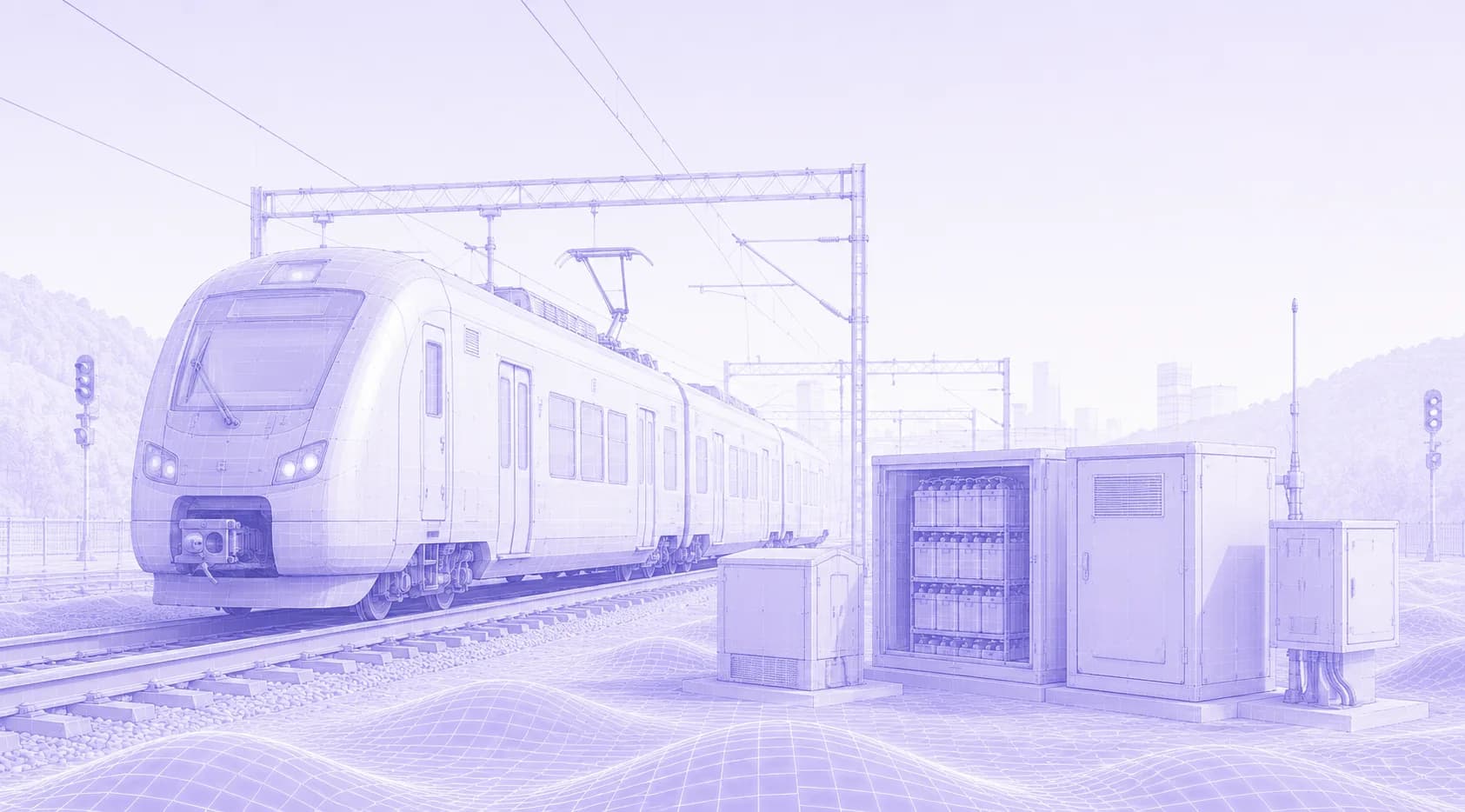
Do railway batteries need an EU battery passport?
Yes. Railway traction and infrastructure batteries count as industrial batteries under Regulation (EU) 2023/1542. That means the 2 kWh capacity threshold decides the outcome, not any railway-specific test. It covers traction batteries on locomotives and shunting units, on-board auxiliary batteries, and standby batteries for signalling and level-crossing infrastructure, provided each one clears the threshold. Every qualifying battery placed on the EU market or put into service from 18 February 2027 needs a passport before it can be sold or commissioned.
The obligation looks forward, not back. A traction battery already fitted to rolling stock in service before 18 February 2027 does not need a passport added after the fact. From that date, each in-scope battery needs a passport the moment it is placed on the market or put into service. But the cut-off tracks the battery, not the vehicle or the site. Replacement packs, mid-life battery overhauls and new-build rolling stock ordered after the deadline all count as newly placed on the market, so each needs its own passport.
That matters more in rail than in most other sectors, because rolling stock and infrastructure assets often run for decades. Fleets bought well before 2027 will still generate passport-carrying batteries through overhaul cycles, mid-life refurbishments and transfers between operators. The obligation reaches almost every fleet eventually, just on a longer timeline than newer asset classes.
Fire safety and RAMS certification alongside the battery passport
Railway batteries already sit inside a dense, sector-specific certification stack. This includes fire behaviour for rolling stock under EN 45545-2, reliability, availability, maintainability and safety (RAMS) under EN 50126-1, traction battery system requirements under IEC 62928, and shock and vibration tests under EN/IEC 61373. None of that is replaced by the EU battery passport. The passport is an extra, EU-wide obligation that runs alongside the existing railway safety and reliability regime, not instead of it. It is a per-battery digital record, reached via a QR code on the battery, not a static label or datasheet.
The two frameworks answer different questions. EN 45545, EN 50126, IEC 62928 and IEC 61373 show whether a battery system is safe and reliable enough to run on a railway, assessed by notified bodies and national safety authorities. The battery passport shows what the battery is made of, how it performs, and what happens to it at end of life, tracked through a standardised digital record accessible via QR code.
For engineering and compliance teams, the practical takeaway is simple: build passport data collection on top of existing certification documentation rather than running it as a separate exercise. Component traceability, materials data and test records gathered for EN 45545 or IEC 62928 approval often overlap with passport requirements. Treating them as one coordinated data set avoids duplicating effort across two compliance tracks.
Who is responsible for a railway battery passport?
Responsibility sits with the economic operator who places the in-scope battery on the EU market or puts it into service. This is the party selling a battery capable of performing its intended function safely. In the railway sector, that is typically the locomotive or rolling stock OEM assembling traction and auxiliary battery systems, or the battery manufacturer where packs are supplied and sold as standalone units.
For imported rolling stock or battery systems, the importer placing the battery on the EU market carries the legal obligation, even where design and manufacturing happened outside the EU. Supply agreements can push data-gathering duties back to component suppliers, but accountability for the passport itself stays with the operator placing the battery on the market.
Infrastructure managers and railway network operators are not automatically exempt either. If a network operator commissions and puts into service a battery system for signalling or level-crossing backup power, rather than buying a pre-commissioned unit from a supplier, that operator can itself become responsible for ensuring a passport exists before the system enters service. Here, the infrastructure manager acts as the economic operator putting the battery into service, and carries the same passport obligation as an OEM or importer would.
Whoever holds that obligation, a battery passport software gives OEMs, importers and infrastructure managers a consistent way to build and maintain the record, rather than treating it as a one-off exercise.
What data must a railway battery passport include?
The passport covers battery identification, material composition, carbon footprint, performance and durability data, and information on recycling and end-of-life handling. For railway assets, performance and durability data carries particular weight, given the long service intervals and heavy duty cycles traction batteries are built to withstand.
Supply chain data is also part of the picture, covering the origin of key raw materials used in cell and pack manufacture. For large traction packs, this sits alongside the due diligence obligations that apply from 18 August 2027. It is worth gathering this sourcing data on the same timeline as the rest of the passport record, rather than as a separate exercise later.
The exact data fields, thresholds and formats are still being finalised through implementing and delegated acts under the regulation. For the full data model and how it is expected to be structured, see our EU battery passport data points guide which tracks the delegated acts as they are adopted
Infrastructure batteries vs traction batteries: different profiles, same regulation
Railway battery assets split into two profiles that behave very differently against the 2 kWh threshold. Infrastructure batteries support signalling systems, level crossings and backup power for track-side equipment. These are often smaller, standby-duty units, and some may sit close to or below the threshold depending on the installation. Traction batteries, fitted to locomotives, shunting units and on-board auxiliary systems, are large propulsion-scale packs that are almost always well above it. Under Article 77, industrial batteries with a capacity greater than 2 kWh require a passport; those at or below 2 kWh do not.
This means the passport obligation cannot be applied uniformly across a railway asset base. Traction batteries can generally be assumed in scope and planned for accordingly. Infrastructure batteries need a capacity check per installation. A small trackside standby unit and a substation-scale backup system for a major junction can sit on opposite sides of the threshold, despite serving a similar function.
The two asset classes also run on different renewal cycles. Traction batteries are replaced or overhauled on rolling stock maintenance schedules. Infrastructure batteries are typically replaced on their own standby-duty lifecycle, often independent of any vehicle programme. Operators managing both need to track passport status by asset class rather than by a single fleet-wide rule, since the two will reach the 2027 deadline through different procurement channels and timelines.
Key dates for railway OEMs and operators
The battery passport obligation is one part of a phased rollout under Regulation (EU) 2023/1542. Our EU battery passport timelinesets out the full schedule. For the railway sector, the dates that matter most are:
Regulation applies
Regulation (EU) 2023/1542 starts applying across the Union, replacing the old Battery Directive 2006/66/EC in stages. For railway OEMs and infrastructure suppliers, this is when the broader compliance clock starts running across labelling, due diligence and passport obligations, even though the passport requirement itself does not apply until 2027.
Carbon footprint - rechargeable industrial batteries above 2 kWh
Carbon footprint declaration obligations for rechargeable industrial batteries above 2 kWh apply from this date, or 18 months after the Commission's carbon footprint methodology and format acts enter into force, whichever is later. Exact timing depends on those acts. Traction battery manufacturers should expect to declare carbon footprint data on packs in this category, alongside the performance and durability data already tracked for EN 50126 and IEC 62928.
Battery passport mandatory
Every industrial battery above 2 kWh placed on the EU market or put into service needs a QR-accessible passport under Article 77, with the QR code itself required under Article 13(6). This is the key deadline for the railway sector. Traction and auxiliary batteries on new-build and overhauled rolling stock, and any qualifying infrastructure batteries, need a passport in place from this date.
Supply chain due diligence
Supply chain due diligence obligations under Articles 48 to 50 apply, following the two-year postponement under Omnibus IV. For traction battery manufacturers sourcing raw materials for large propulsion-scale packs, this adds a formal due diligence policy on top of the passport's own supply chain data fields.
How railway OEMs can prepare
1. Inventory battery assets by capacity and duty class Build a register that separates traction and auxiliary batteries from infrastructure batteries, and records the rated capacity of each. Use this to work out which units clear the 2 kWh threshold, and when they will need a passport.
2. Map economic operator responsibility across the supply chain Identify who places each battery type on the EU market. This could be the rolling stock OEM, a standalone pack supplier, an importer, or the network operator commissioning infrastructure systems. Confirm contractually who owns passport data collection.
3. Align passport data collection with existing certification records Cross-reference the material, performance and traceability data already gathered for EN 45545, EN 50126, IEC 62928 and IEC 61373 approval. Build passport data collection on top of it, rather than starting a parallel process.
4. Plan for long asset lifecycles Set up passport and QR-code infrastructure that can stay accurate over decades of service. This includes processes for updating the record through overhauls, mid-life refurbishments and transfers between operators.
5. Prepare for the 2026 and 2027 deadlines in sequence Treat carbon footprint declaration, passport issuance and supply chain due diligence as one connected data programme. The underlying data for all three overlaps heavily, so it is best gathered once rather than three times.
Railway battery passport FAQ
Do signalling and level-crossing batteries need a battery passport?
Only if they qualify as a rechargeable industrial battery above 2 kWh. Many infrastructure standby units are smaller than typical traction packs, so check capacity per installation rather than assuming it across the whole infrastructure fleet.
Does EN 45545 or IEC 62928 certification satisfy the battery passport requirement?
No. EN 45545-2, EN 50126-1, IEC 62928 and EN/IEC 61373 are railway-specific safety and reliability certifications, assessed by notified bodies and national safety authorities. The battery passport is a separate EU-wide obligation covering materials, carbon footprint, performance and supply chain data. It applies alongside those certifications, not instead of them.
Do locomotives already in service before 2027 need a passport retrofitted?
No. This is a forward-looking obligation, not a retrospective one. A traction battery already in service before 18 February 2027 does not need a passport added afterwards. From that date, each qualifying battery needs a passport the moment it is placed on the market or put into service. So replacement packs, overhauled units and new-build rolling stock placed on the market from that date do need one.
Who is responsible for the passport on an imported locomotive?
The importer placing the locomotive, or its battery system, on the EU market carries the legal obligation, even where the vehicle was designed and built outside the EU. Data-gathering can be pushed back to the original manufacturer contractually, but the compliance duty stays with the importer.
Are traction batteries automatically above the 2 kWh threshold?
In practice, almost always. Traction batteries are propulsion-scale packs sized to move locomotives and shunting units. They sit well above 2 kWh in nearly every case. Infrastructure batteries are the asset class that needs a closer, case-by-case capacity check.
A note on pending implementing acts
Several of the technical specifications behind the battery passport are still being finalised through implementing and delegated acts. This includes detailed data formats, carbon footprint calculation methods and the precise scope of some due diligence requirements. The obligations described on this page come from Regulation (EU) 2023/1542 itself. Where supporting acts are still pending, we have noted that explicitly rather than guessing at detail that has not yet been published.